
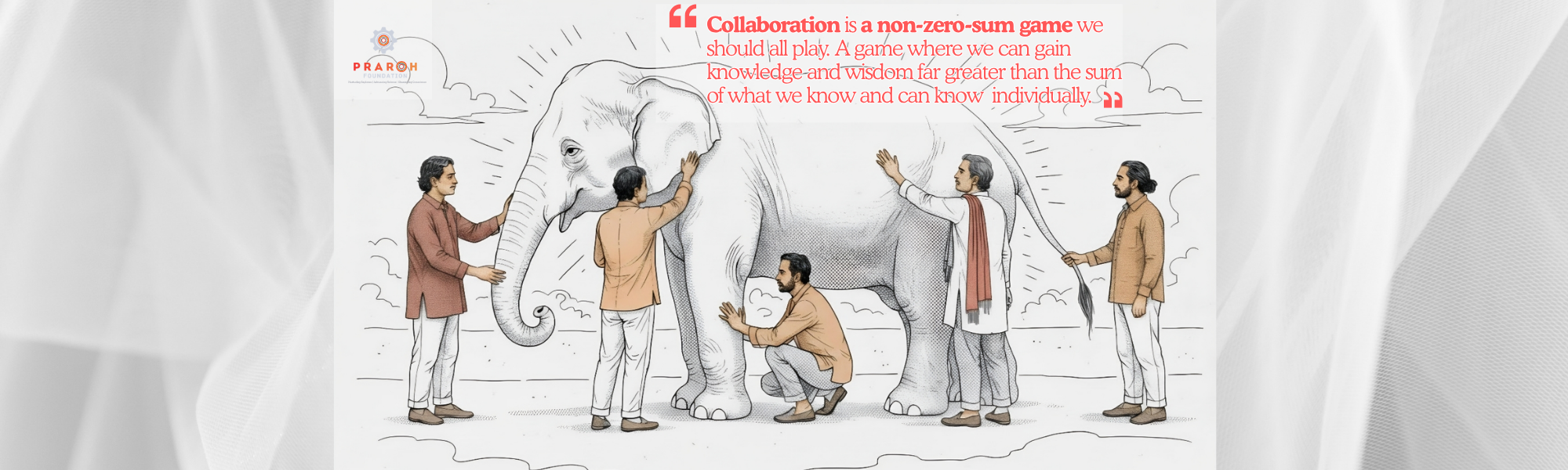

What can we see together that neither of us could see alone? When we move beyond defending proprietary viewpoints, collaboration ceases to be a competition and becomes a journey into the larger system.
When we cling tightly to our own point of view, collaboration feels like a battle of egos. In this dialogue, Ayushi and Rupesh revisit the famous parable of the elephant to explore what happens when we stop trying to win debates and start building a fuller picture together.
Rupesh: Have you heard the story of the elephant and the five blind men?
Ayushi: You mean the old parable that appears in ancient Indian traditions? Five blind men encounter an elephant, each touches a different part of it, and each comes away with a very different idea of what an elephant is.
Rupesh: Exactly.
Ayushi: And each of them mistakes his partial experience for the whole truth.
Rupesh: Yes. Can you tell us that story?
Ayushi: Oh! So we are switching roles today?
Rupesh: Just for a while.
Ayushi: Okay then. Let me be the storyteller.
Once, five blind men who had never encountered an elephant were told that one had arrived in their village. Curious to understand what this strange animal was like, they went to meet it.
The first man reached out and touched one of the elephant’s broad sides.
“Ah,” he said confidently. “An elephant is like a wall—large, solid and flat.”
The second man happened to hold the trunk.
“A wall? Not at all,” he replied. “An elephant is long and flexible, like a thick snake.”
The third man touched one of its legs.
“Both of you are mistaken. An elephant is like the trunk of a tree—round, strong and firmly planted.”
The fourth man felt one of its wide ears.
“How can you say that? An elephant is thin and broad, like a large fan.”
The fifth man caught hold of the tail.
“You are all making this unnecessarily complicated. An elephant is clearly like a rope.”
Soon, the five men began arguing.
Each had directly experienced the elephant. Each could describe what he had touched. And from within that experience, each felt completely certain that the others must be wrong.
Yet the elephant stood quietly before them—larger than any one of their descriptions.
Rupesh: Very good. If I now ask you to connect this with one of our earlier episodes, which one comes to mind?
Ayushi: Let me think…
I guess Episode 3—the one about different perspectives. You told the story in which the teacher saw the little girl tasting one strawberry after another and interpreted her behaviour very differently from what the girl herself was actually trying to do.
Rupesh: Right. Episode 3. I was thinking about the same connection.
Now let me ask you something.
What might have happened in the elephant story if those five men already understood that none of us can experience or know the whole truth about something? That reality may have a depth and breadth much greater than what any one of us can presently see?
Ayushi: Then instead of continuing to argue, they might have communicated with each other, compared what each person had experienced, and moved a little closer to understanding the elephant.
Rupesh: Imagine if the person holding the tail had said:
“Interesting. I am experiencing something like a rope, but you are describing something like a wall. Perhaps we are touching different parts of something much larger.”
Suddenly, disagreement in the form of discussion, instead of debate, gives more useful information.
Ayushi: Because the other person no longer has to be wrong simply because their experience is different from mine.
Rupesh: Precisely.
And that requires a particular kind of humility.
The man touching the ear should not deny that it feels solid and cylindrical merely because someone else is touching a leg.
The humility lies in being able to say: “What I know may be limited, untested, not useful in certain contexts, etc.”
Ayushi: Then they don’t have to abandon their own experience in order to listen to someone else’s.
Rupesh: And once they begin doing that, they can start building a richer picture together.
Not necessarily the complete truth. Even after combining all five observations, there may still be parts of the elephant that none of them has explored. But they can certainly move closer to it.
Ayushi: So this goes beyond simply saying, “You have your perspective and I have mine.”
Rupesh: Much beyond that.
Sometimes we speak about respecting perspectives as though the final goal is: “You believe what you believe, and I will believe what I believe.”
That may prevent an argument, which is useful sometimes. Especially when minds are unclear and hostility is in the air. But it does not necessarily help either of us understand the world better.
The more interesting question is: “What can your perspective show me that mine currently cannot?”
Ayushi: Or perhaps, “What can we see together that neither of us could see alone?”
Rupesh: Yesss… better.
But now let me ask you another question.
Can those five men actually collaborate well without first having some system for how they should collaborate? What comes first—the rules of collaboration, or the collaboration itself?
Ayushi: Ah, I know this one. It sounds like a chicken-and-egg problem.
But if they are not already part of some formal organisation, I suppose collaboration begins the moment they decide to do something together. They probably don’t need to sit down first and write a constitution for examining elephants.
Rupesh: Thankfully.
Ayushi: Hehe.
They would probably begin with the problem in front of them.
One person says, “I felt something like a wall.” Another says, “I found something like a rope.”
As they try to combine those observations, they may gradually realise they need some way to work together. Perhaps they need to take turns speaking. Perhaps they need to ask one another questions. Perhaps they should explore parts of the elephant that none of them has touched yet.
Rupesh: Good. And would the same way of collaborating work for every problem?
Ayushi: Probably not. It would depend on what they are trying to accomplish, what each person can contribute, and also on their limitations.
If their task is simply to describe the elephant, sharing observations might be enough. But if their task is to safely guide the elephant somewhere, they would need a very different level of coordination.
Rupesh: Exactly. So perhaps collaboration does not always begin with a complete system already designed for it. It may begin simply with a shared purpose and an attempt to work together. And through that attempt, people gradually discover what kind of structure they need.
But there is another interesting layer here.
Ayushi: Another layer?
Rupesh: Yes. The elephant itself is one system they are trying to understand. But the way the five men organise themselves to understand it is another system—their system of collaboration.
Ayushi: So there is the system being studied, and there is also the system being used to study it.
Rupesh: Exactly.
Suppose they agree to listen to one another, compare observations, ask questions, explore different parts of the elephant, and revise their conclusions when new evidence appears. Those things are not properties of the elephant. They are properties of the way the group has decided to explore it.
Ayushi: And that way of working might itself need to change as they learn.
Rupesh: It should. If their method of working together is not helping them understand the elephant better, they should be willing to improve the method too.
“They are actually doing two things at once: learning about the elephant, and learning how to learn about the elephant together.”
Ayushi: So the collaboration itself evolves.
Rupesh: Yes. And once they discover some useful ways of working together, those ways begin influencing what they do the next time they encounter a difficult problem.
Ayushi: Ah. So people create a system of collaboration, and that system begins shaping how they behave.
Rupesh: Precisely. That feedback is important.
And notice what allowed our five men to take the first step in the first place. Each of them had to become comfortable saying: “What I know may be only one part of something much larger.”
Once saying “I don’t know the whole thing” stops feeling like defeat, exploration becomes much more interesting. Instead of fearing being proved wrong, we can start enjoying the discovery of what we were missing.
Ayushi: So curiosity starts replacing the need to defend our position.
Rupesh: Yes. And creativity and collaboration help us overcome at least some of the limitations of any one observer. That brings us into a territory I particularly enjoy. I sometimes think of it as systemic and systematic thinking.
Ayushi: Systemic and systematic? Interesting.
Rupesh: Yes. I am putting those two ideas together deliberately.
By systemic, I mean trying to see the larger whole—the different parts, the connections between them, the surrounding context, and how a change in one place might influence something elsewhere. By systematic, I mean exploring that whole with a method—observing carefully, comparing evidence, questioning assumptions, testing ideas, and improving our method when the evidence shows a better one may be possible.
Ayushi: So one is about recognising that reality is made of interconnected systems, and the other is about how we go about understanding those systems.
Rupesh: That’s a good way of putting it. I sometimes explain the systemic part as the ability to zoom in and zoom out.
Think about looking at a digital map. When you zoom out, you see countries, regions and how different places are positioned in relation to one another. Then you zoom in. A country becomes states or provinces. Zoom further, and you find districts, cities and towns. Then roads, neighbourhoods, buildings and people. What appeared to be a single object at one level becomes a collection of many parts and relationships at another.
Ayushi: And if I remain zoomed in all the time, I might understand one street extremely well but have no idea where that street sits in the larger city.
Rupesh: The reverse is also equally important. If you remain zoomed out, you may understand the general shape of a country while knowing almost nothing about what is actually happening in one particular village. So understanding often requires movement between levels.
Ayushi: Zoom out to understand how things fit together. Zoom in to understand the individual parts.
Rupesh: Yes. And then zoom out again. Because once you understand one part better, your understanding of the whole may also change. It is not a one-way journey.
Ayushi: So even our elephant becomes layered.
Rupesh: Very quickly. We can study the elephant as one animal. Then we can zoom in and study its organs, nervous system, cells or behaviour. Or we can zoom out and look at its herd, habitat, food sources, relationships with other species, or its place within an ecosystem. Where we draw the boundary around the system depends partly on the question we are trying to answer.
Ayushi: Okay. I think I am following you so far.
Rupesh: Good. Because now I want to make it slightly more complicated.
The system of collaboration does not only help those five people understand the elephant better. It can also help each person understand themselves better.
Ayushi: How?
Rupesh: Let us modify the story.
Instead of all five people being blind, imagine five observers with different abilities and limitations.
One person is short-sighted. They can see nearby details extremely well but struggle to see the overall shape from a distance. Another can see the broad outline very clearly from far away, but misses fine details. A third person is wearing glasses tinted with a particular colour, so some features stand out more strongly while others become difficult to distinguish. Another cannot examine the elephant by touch, but has exceptionally good hearing and notices sounds and rhythms that everyone else overlooks. And perhaps the fifth has spent years observing animal movement, so she notices patterns in how the elephant walks that the others would never think to examine.
Ayushi: So now they are not merely standing at different parts of the elephant. They are experiencing the same elephant through different capacities.
Rupesh: Exactly. And when they start comparing their observations, something else can happen.
The first person may realise: “I am very good at seeing details, but I routinely miss the larger pattern.” Another might discover: “I understand the overall structure quickly, but sometimes I overlook important details.” The person with the coloured glasses may gradually recognise that the lens itself is influencing what appears important to them.
Ayushi: So collaboration is not only helping them build a better model of the elephant. It is also helping them build a better model of themselves.
“Other people do not merely contribute information that I lack. Through interacting with them, I begin discovering how I know, where I am strong, what I habitually overlook, and which lenses I did not even realise I was wearing.”
Ayushi: Oh wow. So now we have the elephant as one system, the five people as individual systems, and their collaboration as another system connecting them.
Rupesh: Yes. And all of them are influencing one another while the exploration continues.
Ayushi: This is getting wonderfully complex. I think I finally understand why people usually don’t want to address the elephant in the room.
Rupesh: Hehe. Especially when the elephant turns out to contain several more elephants.

Leave a Reply