
We usually imagine freedom as the absence of external control—but what if the invisible command comes from conditioned influences within us that we cannot see?
What if the biggest barrier to freedom is not outside pressure, but the hidden patterns inside our own minds? In this dialogue, Ayushi and Rupesh explore how old experiences quietly shape our reactions—and how we can begin untangling the invisible knots that dictate our choices.
Ayushi: So, Mr Morpheus, can you tell me more about the freedom you mentioned in our last conversation?
Rupesh: Hehe, that nickname has followed me into another episode now. But yes. To understand freedom, perhaps we should first ask what prevents us from being free.
Ayushi: And the prison here is maya…or the Matrix?
Rupesh: Those are useful metaphors, but any name we choose will fall short. In our last conversation, we saw that we often misinterpret our own mental model of the world as actual reality and ignore alternate views. But don’t you think another important question for everyone is, how our own mental model is formed?
Ayushi: Interesting, so the last story was about understanding each other’s perspective. But to understand how our own perspectives form is equally important. Is that what you are trying to say?
Rupesh: Yes, you got it right. Let me tell you a story.
Ayushi: Okay…so long long ago…
Rupesh: Yes, long long ago, there lived a monk, who was known for his wisdom and mastery over his senses. On account of this, he was entrusted with a respected monastery that was situated in a distant valley. It seemed like there was almost nothing that really disturbed him, and many also believed that he had attained great inner freedom by virtue of his wisdom.
But there was one thing that disturbed him: Whenever the monastery bell rang, he felt very uncomfortable and sometimes even frightened at the sound of it. If it rang while he slept, he would wake drenched in sweat, and his heart racing like nothing else.
“The bell here has a different sound than the other bells that I have heard,” he told himself, “but it is still only a bell. Why should it disturb me?”
After a few days, a forgotten memory surfaced in his mind.
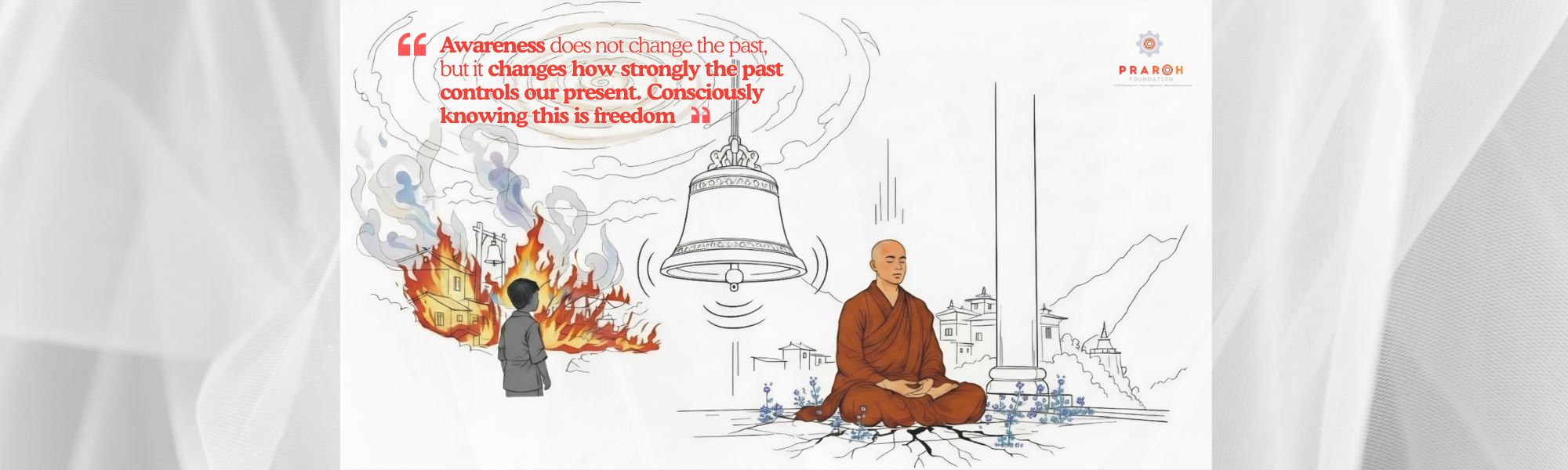
When he was very young, a terrible fire had swept through the village where he lived. When that incident was taking place, an alarm bell was ringing continuously to alert people. At that time, many homes burned down and people died. Although his conscious mind rarely returned to the event, the fear connected with that sound remained deeply buried, yet alive in his mind.
The monastery bell had a similar tone. Each time it rang, his body and mind responded as though the old danger had returned.
Ayushi: So he consciously knew that there was no fire, but another part of him was still reacting to it.
Rupesh: Exactly. His mind had formed an association, a learned connection between that particular sound and danger. During the fire, this association had served survival. When the bell rang at that time, the safest response was to react immediately to find a safer space rather than waiting or analyzing. His brain’s threat-detection systems had learned that this sound means danger.
Such automatic learning helps living beings respond when there is no time for reflection. Memories and associated reflexes that are often deeply buried in the subconscious, try to take control of the steering wheel of thoughts and actions. Like at the monastery, though the bell was being heard in the present, part of his response was still being shaped by the past memories.
Ayushi: But where does freedom enter this story? The fear was not something he chose.
Rupesh: That is precisely the point. He did not choose the fear, but it still had an influence on his choices. Becoming aware of that influence and acknowledging it was his first step towards becoming freer from that particular shackle.
If he had to make an important decision while the bell activated that fear, it might quietly shape his judgment. He could still believe that the decision was entirely his, without recognising that an old fear was influencing the direction that he took.
In those times, the choices would still be his, but they would not be entirely free from influences that he is not aware of.
Ayushi: So a choice can feel free simply because we cannot see what is shaping it.
Rupesh: Yes. We usually imagine freedom as the absence of external control. We think that no one is forcing me, so my choice must be free. But we must understand that the command does not always come from outside. Sometimes, it arises from influences within us that we may not even recognise.
Fear can command us. So can anger, loneliness, shame, habit, the need for social approval, or an old conclusion formed during a painful experience.
Ayushi: Is that what we call the subconscious?
Rupesh: Sometimes. Subconscious is the familiar everyday word. I would say non-conscious processes is a more careful expression for what we are discussing here.
It does not refer to a single hidden room inside the mind. It includes automatic associations, learned emotional responses, habits, bodily reactions and many other processes that influence our thoughts and choices without entering our conscious awareness.
Ayushi: And the fear connected to the bell was one such process.
Rupesh: Yes. I sometimes describe such a connection as a knot. I do not mean a literal knot in the brain, nor am I presenting it as an established scientific term. It is a metaphor for memory, emotion, bodily response and belief that are tightly connected through an intense experience. It often results in automatic or reflex-like reactions.
When something in the present moment triggers that earlier experience, the knot is pulled. We may feel fear, anger, shame or discomfort without understanding why we feel like this.
Ayushi: And what did the monk do after recognising his knot?
Rupesh: Whenever the bell rang, he started to sit with himself in silence. He observed his bodily sensations and thoughts without immediately resisting them or running away.
Each time the bell sounded without a fire following it, his mind received new conscious evidence: This is not the old danger. I am safe here.
Gradually, the fear weakened. The bell became merely a bell again. As the hidden knot loosened, the monk moved one step closer to freedom.
“Awareness did not change the past, but it definitely changed how strongly the past controlled the present.”
Rupesh: Beautifully put. Awareness gave him the possibility of responding to the bell as it existed now. He stopped seeing it through the automatic response associated with what it had meant in childhood.
Of course, the story is a metaphor and not a universal prescription. Not every trauma can be resolved through meditation alone, and I believe some experiences are better approached with professional support or alongside someone we trust. Sometimes, accepting help is itself a step towards freedom.
Ayushi: Are all hidden influences created by traumatic experiences?
Rupesh: No. Some arise through intense experiences, but others exist and grow through repetition. Family expectations, cultural beliefs, praise, humiliation, habits, relationships and the need for acceptance can all shape what begins to feel natural to us.
A person may choose a career partly from genuine interest and partly from fear of disappointing their family. Someone may enter a relationship thinking that they are in love, but deep down it might have also come from loneliness. Another may remain silent partly from wisdom and partly from fear of being wrong.
Our motives are rarely pure or singular.
Ayushi: Then does the presence of these influences mean that none of our choices are free?
Rupesh: I would not divide choices so sharply into free and not free. Freedom may exist in degrees.
A choice can be genuine while still being influenced. The important question is not whether we can remove every influence, that may be impossible. We should think on the lines whether we can recognise more of what is moving us and participate more consciously in deciding our response.
Ayushi: And after examining everything, we may still make the same choice?
Rupesh: Certainly. Someone may examine family expectations carefully and still choose the career their parents suggested. The visible decision remains the same, but something important has changed within. There is a difference between being pushed unknowingly and consciously accepting a path after understanding the forces involved.
Ayushi: Then inner freedom is not doing whatever we want.
Rupesh: No. Because what we want may itself be shaped by an invisible knot.
Inner freedom is about gradually expanding space in which we are able to notice what is influencing us, examine it with honesty and choose as consciously as our present understanding allows.
Ayushi: So freedom does not arrive all at once? Every hidden influence we recognise gives us a little more room to choose, right?
“Liberation may not always be one dramatic escape. Sometimes it happens when we recognise patterns, loosen one knot, and make more conscious choices.”

Leave a Reply